nginx fixed CVE-2026-97205 in version 1.31.7, released on 14 October 2026. On nginx servers that have asynchronous file I/O (AIO) turned on and serve Server Side Includes (SSI) pages with include virtual commands, the flaw makes nginx reuse memory it has already released. The usual result is a crashed nginx worker process; if ASLR is disabled or can be bypassed, remote code execution is also possible. nginx 0.8.11 through 1.31.6 is affected, and the fix is in 1.30.6 and 1.31.7.
If you run nginx yourself, first check whether the aio and ssi directives are switched on in your configuration: both are off by default, and unless both are on, this flaw does not affect you. If they are, update to 1.30.6 or 1.31.7 today. The same release fixes four other vulnerabilities, so updating is the right move even if you don't meet the conditions. As of 22 October 2026 the flaw is not in CISA's Known Exploited Vulnerabilities catalog.
This post covers what goes wrong, how to check whether your server is affected and what to do if you can't update right away.
What goes wrong
nginx is the web server that sits in front of many sites and answers requests. SSI is an old feature that lets nginx stitch the output of other pages into a page as it sends it; the include virtual command means "put the content of this address here". AIO lets nginx carry on with other work while it waits for a file to be read from disk.
According to nginx's changelog, when the two are used together in certain configurations, nginx can keep using a block of request memory after releasing it. This class of bug is called use after free (CWE-416). F5's description in the record says the result is a worker crash or memory corruption, and code execution if ASLR (the protection that places memory at random addresses on every run) is disabled or the attacker can bypass it.
Think of a kitchen where the counter is cleared while a plate is still being finished. When the cook turns back to add the last ingredient, a different order's plate is now sitting there.
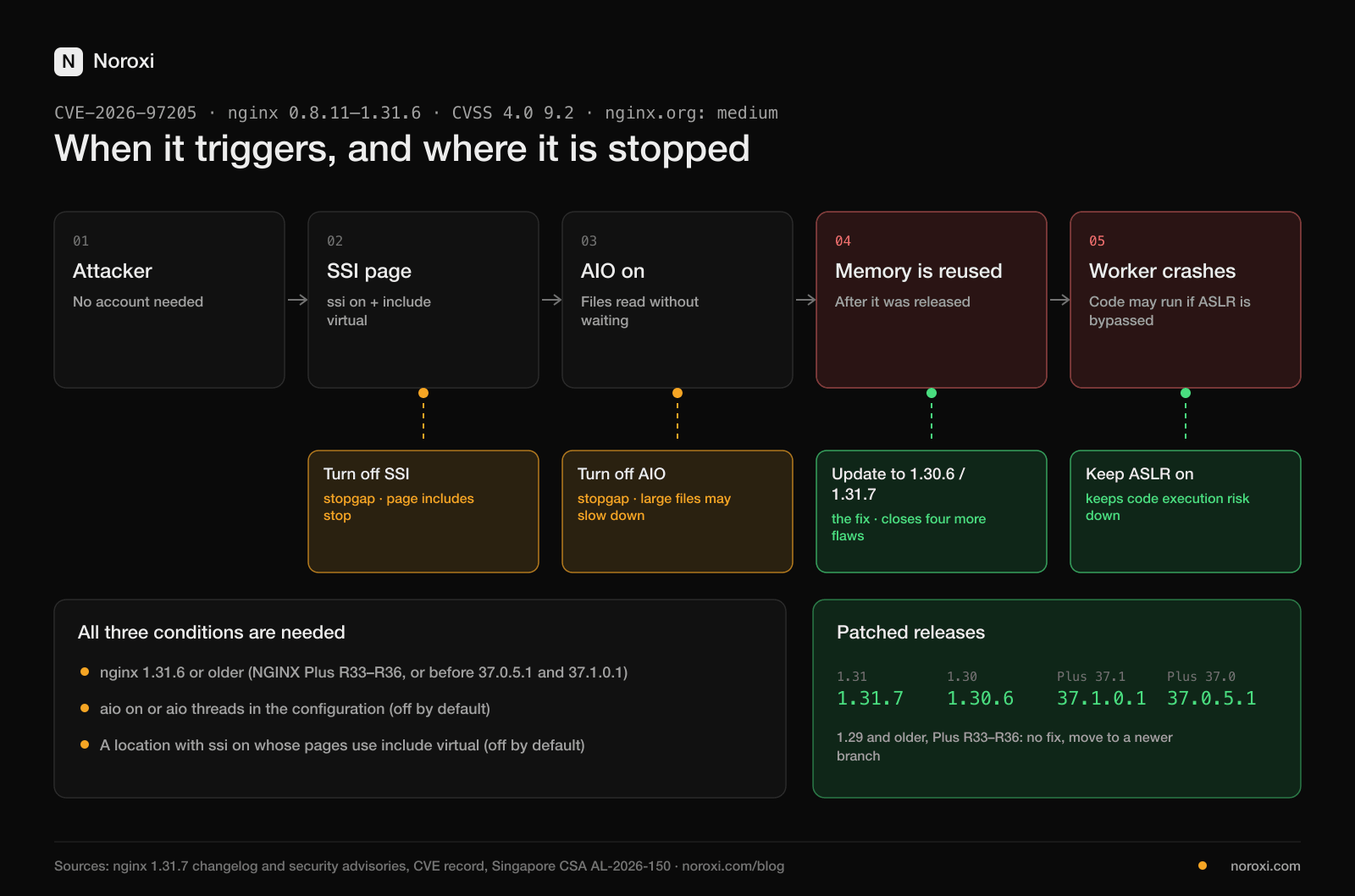
Which servers are at risk
The flaw needs three things at once:
- nginx 1.31.6 or older (NGINX Plus R33–R36, or 37.x before 37.0.5.1 and 37.1.0.1),
aio onoraio threadsin the configuration,- a location with
ssi onwhose pages containinclude virtual.
These features show up on older news, catalog and corporate sites that assemble pages from fragments on the server. Applications such as WordPress or Laravel don't need SSI; unless someone switched it on deliberately, it is off. No source measures how many servers carry this configuration.
F5 scored the flaw 8.1 under CVSS 3.1 and 9.2 under CVSS 4.0. nginx's own security page lists its severity as medium. The gap comes from how narrow the conditions are: the risk is high on a server that meets them and zero on one that doesn't.
No account is needed: an ordinary request from the internet can be enough on a server that meets the conditions. Code execution depends on ASLR being disabled or bypassed, and ASLR is on by default in most current Linux distributions. In that case the most likely effect is a site that slows down or drops out as workers keep crashing.
Is your server affected?
Two commands on the server show your version and configuration:
- Version:
nginx -v - Full configuration, including included files: search the output of
sudo nginx -Tforaio,ssi onandinclude virtual. For example:sudo nginx -T 2>/dev/null | grep -nE '^\s*(aio|ssi)\s|include virtual'
If all three aren't there, this flaw doesn't affect you. nginx installed from Ubuntu, Debian or Red Hat packages can show a different version number, because distributions backport fixes into their own packages; Debian shipped the fix in package 1.30.4-8. Check your distribution's security notice.
On shared hosting your provider runs nginx, and you usually can't switch SSI on yourself. Ask them which nginx version the server runs and whether this fix is installed.
If your server announces its version in the response header (such as Server: nginx/1.30.4), paste that line into Noroxi's banner to CVE lookup to see every record that affects your version. It doesn't scan anything; it only reads the text you paste. To stop showing the version, set server_tokens off;.
nginx ships security releases a few times a year. With a free Noroxi account you can add nginx to the list of software you run. Add your version too and you'll only hear from us when a new flaw affects that version (how it works). If you'd rather not sign up, we send the vulnerabilities exploited this week in one email every Monday.
What to do
1. Update
| Your version | Patched release |
|---|---|
| nginx 1.31.x | 1.31.7 |
| nginx 1.30.x | 1.30.6 |
| nginx 1.29 and older | no fix: move to 1.30.6 or 1.31.7 |
| NGINX Plus 37.1 | 37.1.0.1 |
| NGINX Plus 37.0 | 37.0.5.1 |
| NGINX Plus R33–R36 | no fix for these branches: move to a patched R37 release |
Reload nginx after updating (sudo nginx -t && sudo systemctl reload nginx). Version 1.31.7 closes four more vulnerabilities: a buffer overflow when alias and rewrite are combined (CVE-2026-15176), a buffer overflow in string expressions with variables (CVE-2026-93479), a request body limit bypass over HTTP/3 (CVE-2026-95101) and an uninitialized key during TLS session ticket key rotation (CVE-2026-97629). That's why updating makes sense even if you don't use SSI.
2. If you can't update right away
The stopgap cited by Singapore's Cyber Security Agency (CSA) is to remove one of the conditions: turn off AIO (aio off;) or SSI (ssi off;), then test and reload the configuration. Turning off SSI breaks pages assembled with include virtual; turning off AIO can slow down sites that serve large files. Check which one touches your site less. Neither closes the flaw; each only stops it from being triggered.
Don't turn off ASLR: it is what keeps the code execution risk down. On Linux, cat /proc/sys/kernel/randomize_va_space should print 2.
3. After updating
Look for worker process ... exited on signal lines in the nginx error log (/var/log/nginx/error.log). On a server that meets the conditions, if those lines line up with requests to SSI pages, someone may have been sending requests that crash workers. If you suspect code execution, look for unfamiliar files and processes on the server and rotate the passwords and keys it holds. If you find traces and the server holds personal data, the GDPR gives you 72 hours from becoming aware of a breach to notify your supervisory authority (Article 33). This is not legal advice.
Not sure?
If you are not sure whether your configuration meets the conditions or whether your host has installed the fix, get in touch with the Noroxi team. We'll look at it with you.
Record details
| Record | CVE-2026-97205 |
| Affected | nginx 0.8.11–1.31.6 (nginx.org); NGINX Plus R33–R36, 37.0.0–37.0.5, 37.1.0 |
| Weakness | Use after free (CWE-416) |
| Conditions | aio on + ssi on + include virtual in the page (both off by default) |
| Privileges needed | None: no account, no user interaction |
| Severity | F5: CVSS 3.1 8.1 high, CVSS 4.0 9.2 critical; nginx.org: medium |
| Code execution | Only if ASLR is disabled or can be bypassed |
| Exploited in the wild | Not in CISA KEV (22 October 2026) |
| Reported by | cyberlancer (credited by nginx and F5) |
Timeline
| Date | What happened |
|---|---|
| 14 October 2026 | nginx released 1.31.7; F5 published the record and advisory K000162608 |
| 21 October 2026 | Singapore's CSA issued an alert covering three nginx memory flaws |
Patched releases for every version
| Product and branch | Affected | Patched release |
|---|---|---|
| nginx 1.31 | 1.31.0–1.31.6 | 1.31.7 |
| nginx 1.30 | 1.30.0–1.30.5 | 1.30.6 |
| nginx 0.8.11–1.29 | all (nginx.org) | no fix, 1.30.6 or 1.31.7 |
| NGINX Plus 37.1 | 37.1.0 | 37.1.0.1 |
| NGINX Plus 37.0 | 37.0.0–37.0.5 | 37.0.5.1 |
| NGINX Plus R33–R36 | all | no fix, R37 |
| Debian (package) | 1.30.4-8 |
Sources
- nginx: Security advisories
- nginx: Changes in 1.31.7
- F5: K000162608
- Singapore CSA: Critical vulnerabilities in F5 NGINX products (AL-2026-150)
- nginx documentation: the aio directive and the ssi directive
- NVD: CVE-2026-97205
- Noroxi record: daily exploit probability and changes to the record
- Every recorded F5 vulnerability
This post contains no exploit code and no links to attack tools.
Exploited this week · every Monday
New KEV entries, fresh PoCs, WordPress triage and what to do this week. No account needed.