PHP published two security advisories on 21 October 2026: CVE-2026-109618 and CVE-2026-109619. Known together as PHP2Shell, they can let someone with no account run code on a server that runs PHP, with the rights of the web server account. The flaws are in PHP itself, so it doesn't matter whether the site is WordPress, Magento, Laravel, Drupal or a hand-written PHP script: clean application code does not protect a server running a vulnerable PHP. The fixes are in 8.2.35, 8.3.36, 8.4.27 and 8.5.12, and PHP rated both flaws 9.2 out of 10.
If PHP runs on your site or server, move to the patched release for your branch today and restart PHP afterwards. On shared hosting your provider updates PHP, so ask them whether the server's PHP has been patched. Updating plugins or the application does not fix this. Cloudflare reported attack traffic against its customers' sites on 21 October. As of 21 October 2026 neither flaw is in CISA's Known Exploited Vulnerabilities catalog.
This post covers what goes wrong, which applications and servers are affected, what changes if you sit behind a service like Cloudflare, how to find your PHP version and what you can do if you cannot update right away.
What goes wrong
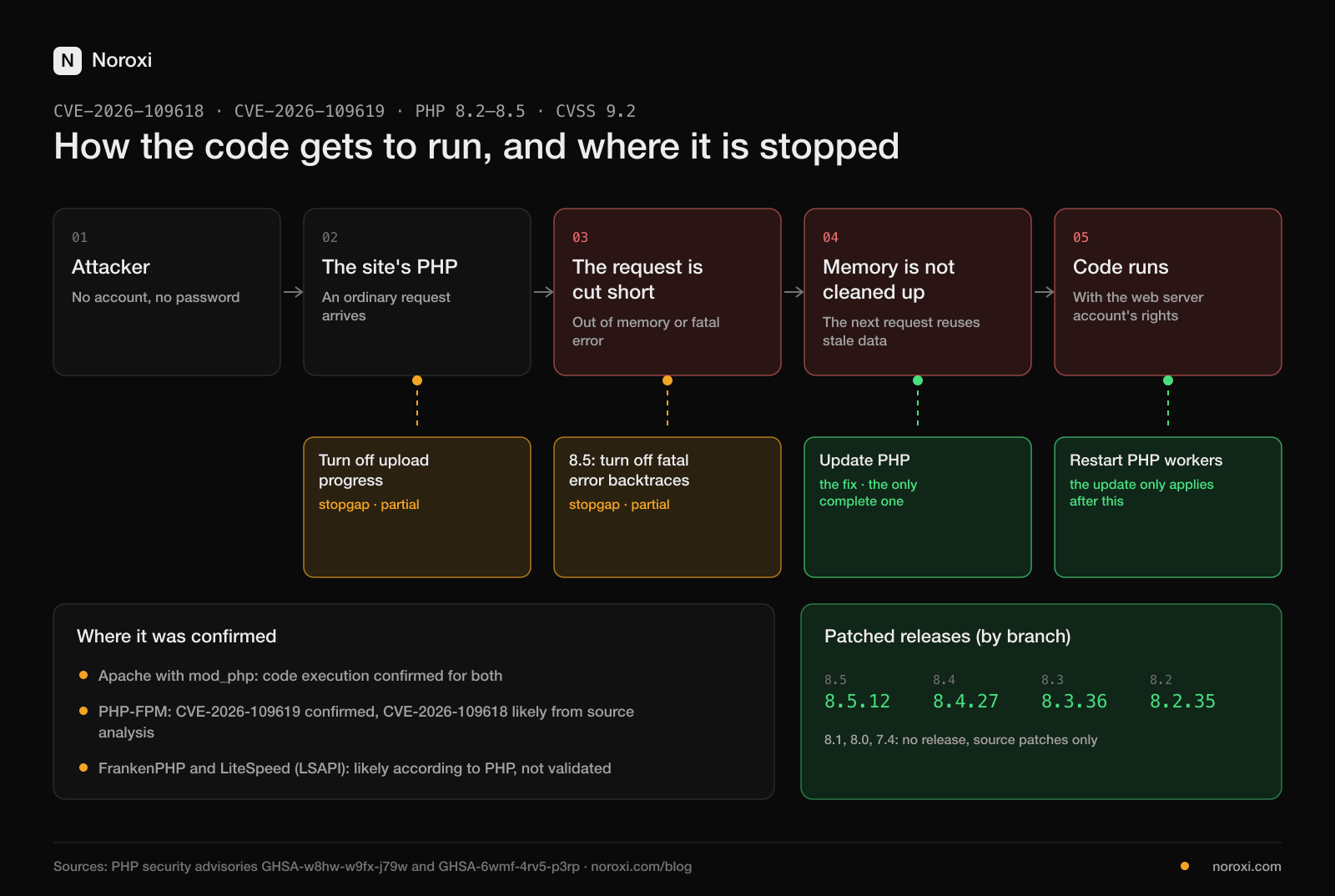
PHP is the program that answers every request to your site. It starts once on the server, and the same process handles thousands of requests in turn. For each request it sets aside a block of memory, releases it when the request ends and moves on to the next one.
According to PHP's advisories, the trouble starts when a request is cut short. Hitting the memory limit or a fatal error can stop a request at an unexpected point. PHP then leaves some of its internal records unreset, still pointing at memory that has already been released. The next request treats those stale records as valid and uses them. This class of bug is called use after free (CWE-416). An attacker who shapes memory the right way can get the server to run their own code.
Think of a waiter who clears a table in a hurry and leaves the last customer's order slip behind. When the next customer sits down, the kitchen reads the old slip and cooks from it. Whoever knows how to write that slip can make the kitchen cook anything.
Code execution is not the only risk. Security firm Sansec says CVE-2026-109618 can also leak passwords, session tokens, API keys and TLS private keys from the server's memory. That is why rotating secrets is worth considering on any server that stayed exposed before it was patched (see below).
Not just WordPress
PHP runs on about 69% of websites whose server-side language is known (W3Techs, as cited by Tenable). Calif, one of the research teams behind the discovery, confirmed unauthenticated code execution on current releases of WordPress, Magento, Drupal, Joomla, MediaWiki, Roundcube, phpMyAdmin, Nextcloud, Laravel, Symfony and WHMCS (Sansec). Wiz Research confirmed it on WordPress, Drupal and Joomla (Wiz).
Because the flaw sits in PHP rather than in the application, these are just as exposed:
- hand-written PHP sites and scripts (a contact form, a small admin page, an old campaign page),
- off-the-shelf shops (OpenCart, PrestaShop, WooCommerce, Magento),
- billing and client portals (such as WHMCS), webmail (such as Roundcube) and database tools (such as phpMyAdmin),
- a forgotten old subsite or test install on the same server.
The attack can happen while PHP is first parsing a request, so the application's maintenance mode doesn't help; Sansec notes that Magento and WordPress maintenance modes are ineffective. Every site on a server stays exposed until that server's PHP is updated.
Which servers are most at risk
The risk depends on how PHP is wired to the web server. PHP's advisories put it this way:
- Apache with mod_php: unauthenticated remote code execution was confirmed for both flaws with default PHP limits. With CVE-2026-109618 the attack can happen while the request is first being parsed, before any application code runs.
- PHP-FPM (common with nginx): the session path of CVE-2026-109619 was also confirmed on FPM. For CVE-2026-109618, PHP says source analysis shows FPM is susceptible, but no complete exploit against FPM has been demonstrated.
- FrankenPHP and LiteSpeed (LSAPI): likely affected according to PHP, not validated.
If you don't know which setup you have, ask your hosting provider. On shared hosting many sites share one server, so how far an attacker's code can reach beyond your site depends on how well the host isolates accounts.
If you're behind Cloudflare or another CDN
Cloudflare switched on firewall rules that block known attack requests at 03:02 UTC on 21 October 2026, about nine hours before the flaws were disclosed. The rules are live on every plan, including Free (Cloudflare). According to Wiz, Fastly, Akamai, AWS, Google, Microsoft and Imperva prepared similar protections for their customers. If your site sits behind one of these services, known attack requests can be stopped at the edge before they reach your server, which makes an attack noticeably harder.
That protection does not replace the update. Its limits:
- The rules only see traffic that passes through Cloudflare. If the DNS record isn't proxied (no orange cloud) or your server's IP address can be reached directly, an attacker can skip Cloudflare and go straight to the server. Ask your host or server admin to accept web traffic only from Cloudflare's IP ranges.
- Cloudflare says request data alone does not always provide enough evidence to tell an exploit from legitimate traffic.
- Cloudflare says it has seen attackers mutating their requests to get past the rules. Rules are updated as new techniques appear, but there can be a gap.
- On paid plans (Pro, Business, Enterprise), check that the managed ruleset is set to block; a rule in log-only mode stops nothing.
Subdomains that don't go through Cloudflare (often mail, ftp or cpanel) can give away the server's real IP address. Noroxi's free subdomain finder lists the subdomains of your domain and where they resolve, using public sources only.
Is your site affected?
There are three ways to find your PHP version:
- In WordPress: Tools → Site Health → Info → Server, the "PHP version" row.
- In your hosting panel: "Select PHP Version" or "MultiPHP Manager" in cPanel, or the domain's "PHP Settings" page in Plesk.
- On the server:
php -v(the command line can use a different PHP than the web server; what counts is the version your site runs).
If your version is older than the one listed for your branch in the table below, you are affected. PHP installed from Ubuntu, Debian or Red Hat packages shows a different number (for example 8.3.6-0ubuntu0.24.04.x), because distributions backport fixes into their own packages. In that case check your distribution's security notice.
Some servers announce their PHP version in every response. WP Lens, Noroxi's free WordPress scanner, compares the PHP version your site exposes, plus WordPress core, your plugins and your theme, with known vulnerability records. If the server hides its version, WP Lens says so instead of guessing. For a PHP site that isn't WordPress, get the version from one of the routes above or from your host.
PHP ships security releases regularly. With a free Noroxi account you can add PHP to the list of software you run. Add your version too and you'll only hear from us when a new flaw affects that version (how it works). If you'd rather not sign up, we send the vulnerabilities exploited this week in one email every Monday. Agencies that look after client sites can watch all of them in one list: Noroxi for multiple clients.
What to do
1. Update today
| Your branch | Patched release |
|---|---|
| 8.5 | 8.5.12 |
| 8.4 | 8.4.27 |
| 8.3 | 8.3.36 |
| 8.2 | 8.2.35 (8.2 reaches end of life on 31 December 2026) |
| 8.1, 8.0, 7.4 | no release from the PHP project; install your distribution's or LTS vendor's fix, or better, move to a supported branch |
| 7.3 and older | no fix: move to a supported branch |
After updating, restart Apache or PHP-FPM. Old processes keep running the old code until they are restarted.
On shared hosting your provider does this, not you. A short support ticket is enough: "My site runs PHP 8.x. Have the fixes for CVE-2026-109618 and CVE-2026-109619, released on 21 October 2026, been installed on the server?" If cPanel lets you pick between PHP versions, switch your site to the patched one once it is offered.
Moving from 8.1 or older to a newer branch can break old plugins, themes or hand-written scripts. Take a backup of your site first, then switch.
2. If you can't update right away
According to PHP, updating is the only complete fix; the stopgaps below narrow the known paths but do not make a server safe. If you manage the server yourself, PHP's advisories list:
- Turn off upload progress tracking (
session.upload_progress.enabled=0). Set it inphp.inior the FPM pool;.user.inior a setting made from the application applies too late. PHP suggests leaving it off after patching too if you don't use it. - On PHP 8.5, turn off fatal error backtraces (
fatal_error_backtraces=0). - Remove per-request PHP settings:
php_value/php_flaglines in.htaccess, orPHP_VALUEpassed by nginx. Warnings produced by these settings can trigger CVE-2026-109619. Move the settings you need intophp.ini. - Keep
post_max_sizelow. - Restart every PHP worker after each change.
On a site without file upload forms, blocking multipart requests at the web server or firewall also helps, but it isn't enough on its own. Mattias Geniar reports that on mod_php CVE-2026-109618 was also triggered with an ordinary form post (ma.ttias.be).
For CVE-2026-109618 PHP also lists removing the memory limit (memory_limit=-1) as a stopgap, while noting it is not a complete fix. With no limit, a single request can use up all of the server's memory. Only an administrator who knows the server should weigh it, and the limit should come back after patching.
If none of this is possible, CERT-EU, the cybersecurity team for EU institutions, recommends considering taking internet-facing applications off public networks until a fix is applied and verified (as cited by Tenable).
3. Check your logs and rotate secrets after updating
Wiz suggests watching for unusual multipart requests followed by memory limit errors or repeated 500 responses, unexpectedly large or malformed PHPSESSID cookies sent by the server, and unexplained PHP worker churn. Because the attack happens below the application, the application's own logs may hold little. PHP warns that a clean log is not proof of safety: the failure can happen before PHP writes the message.
If your server stayed exposed before you patched, assume CVE-2026-109618 may have leaked memory and rotate the passwords and keys your PHP application uses: database and email passwords, payment and API keys, and in WordPress the security keys in wp-config.php. Update first, then rotate, or the new secrets can leak the same way.
If you find files you don't recognize, new admin accounts or modified PHP files on the server, treat the site as compromised: the first steps on our hacked WordPress site page also apply to PHP sites that aren't WordPress. If you find traces and the site holds personal data, the GDPR gives you 72 hours from becoming aware of a breach to notify your supervisory authority (Article 33). This is not legal advice.
Code claiming to exploit these flaws is circulating online. According to the PHP Foundation, the PHP security team examined the code that appeared after the leak and did not find a working exploit at the time of release (as cited by Tenable). Unverified exploit code sometimes carries malware, so don't run it against your own site to test.
Not sure?
If you are not sure whether your server is affected, whether your host has installed the fix, whether Cloudflare really sits in front of your server or what the errors in your logs mean, get in touch with the Noroxi team. We'll look at it with you.
Record details
| CVE-2026-109618 | CVE-2026-109619 | |
|---|---|---|
| Record | CVE-2026-109618 | CVE-2026-109619 |
| PHP's title | RCE via OOM corruption | RCE via stale global state |
| Affected | PHP 8.2–8.5 before the fix, per the record; per Calif, the affected code dates back to PHP 5.4.0 | PHP 8.2–8.5 before the fix, per the record |
| Weakness | Use after free (CWE-416) | Use after free (CWE-416) |
| Privileges needed | None: no account, no user interaction | None: no account, no user interaction |
| Severity | CVSS 4.0: 9.2 critical (PHP) | CVSS 4.0: 9.2 critical (PHP) |
| Attack conditions | High complexity, preconditions required | High complexity, preconditions required |
| Exploited in the wild | Not in CISA KEV (21 October 2026); Cloudflare reported attack traffic, watchTowr reported exploitation attempts | Not in CISA KEV (21 October 2026); Cloudflare reported attack traffic, watchTowr reported exploitation attempts |
| Exploit code | Code is circulating; the PHP security team found no working exploit at release | Code is circulating; the PHP security team found no working exploit at release |
| Reported by | Wiz, Ryan (Calif.io), OpenAI | Wiz, Ryan (Calif.io), OpenAI |
The EPSS exploit probability score for new records is calculated the following day; the current value is on each record's Noroxi page.
Timeline
| Date | What happened |
|---|---|
| 1 August 2026 | Calif found several remote code execution paths |
| 11 August 2026 | Calif reported the first bug to PHP |
| 24 August 2026 | Wiz Research reported its findings to PHP |
| 20 October 2026 | Details leaked ahead of release |
| 21 October, 03:02 UTC | Cloudflare enabled firewall rules on all plans |
| 21 October, 07:43 UTC | Cloudflare reported seeing early attacks |
| 21 October, 14:00 UTC | PHP released 8.2.35, 8.3.36, 8.4.27 and 8.5.12 with both advisories, plus source patches for 7.4, 8.0 and 8.1 |
Times are from Sansec and Cloudflare.
Patched releases for every branch
| Branch | Patched release |
|---|---|
| 8.5 | 8.5.12 |
| 8.4 | 8.4.27 |
| 8.3 | 8.3.36 |
| 8.2 | 8.2.35 |
| 8.1, 8.0, 7.4 | no official release; source patch from the PHP security team or your distribution's package |
| 7.3 and older | no fix |
Sources
- PHP: Security advisory, critical remote code execution vulnerabilities
- PHP security advisory: RCE via OOM corruption (GHSA-w8hw-w9fx-j79w)
- PHP security advisory: RCE via stale global state (GHSA-6wmf-4rv5-p3rp)
- Cloudflare: WAF protections against the PHP2Shell vulnerabilities
- Wiz: PHP2Shell research
- Sansec: PHP2Shell
- Tenable: PHP2Shell FAQ
- Mattias Geniar: early mitigation steps for CVE-2026-109618 and CVE-2026-109619
- NVD: CVE-2026-109618 and CVE-2026-109619
- Noroxi records for CVE-2026-109618 and CVE-2026-109619: daily exploit probability and changes to the record
- Every recorded PHP vulnerability
This post contains no exploit code and no links to attack tools.
Updated 21 October 2026: added non-WordPress applications, Cloudflare and CDN protection, source patches for older branches, memory disclosure and exploitation status.
Exploited this week · every Monday
New KEV entries, fresh PoCs, WordPress triage and what to do this week. No account needed.