CVE-2026-85706 lets someone with no GitLab account read files from a self-managed GitLab server. It affects GitLab Community and Enterprise Edition 18.7 through 19.3.1. GitLab fixed it in 19.3.2 on 10 September 2026 and rated it 10.0 out of 10. Internet-wide scanning for the flaw started the next morning, and CISA added it to its Known Exploited Vulnerabilities catalog the same day (Cloud Security Alliance).
If you run GitLab on your own server, update to the patched release for your branch today. If the server was reachable from the internet before you patched, treat the passwords and keys stored on it as exposed and rotate them. GitLab.com and GitLab Dedicated customers have nothing to do: GitLab patched those platforms before the announcement.
This post covers what went wrong, who is exposed, how to check your version and which secrets to rotate once you have updated.
What went wrong
GitLab is where many software teams keep their code and run their build pipelines. Plenty of companies host it themselves rather than use GitLab.com, which means one server holds their source code, their CI/CD settings and the credentials those pipelines use.
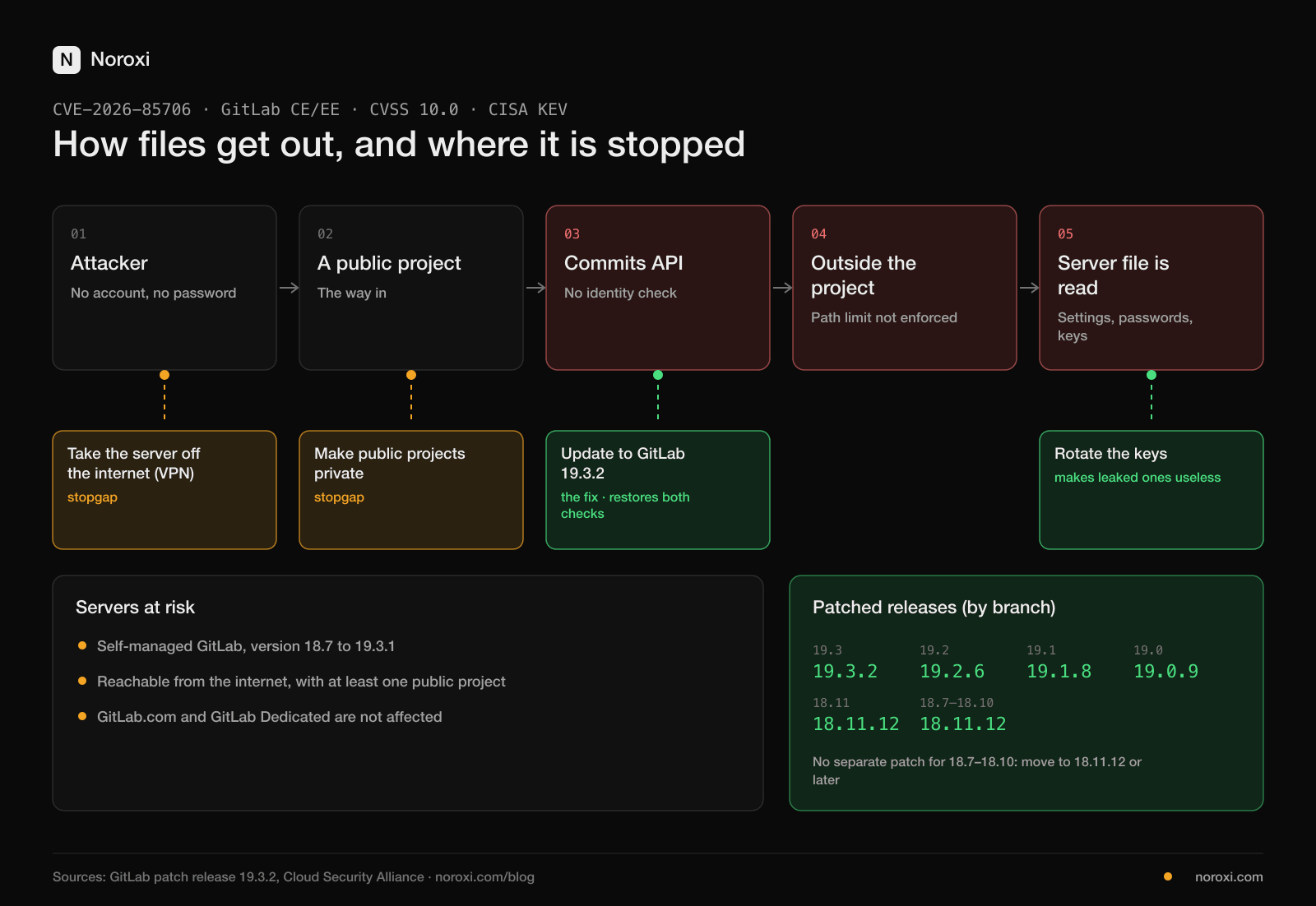
Every change to the code is a "commit", and GitLab exposes commits through an API so other tools can read them. According to GitLab's patch release notes, that API was missing two checks. It did not properly confirm that the requested file stayed inside the project's folder (CWE-22, path traversal). And under certain conditions it did not ask who was making the request at all. Put together, an anonymous request dressed up as "a file from this project" could reach files elsewhere on the server.
Think of a records clerk who photocopies pages from a public shelf for anyone who asks, without checking ID or whether the page really came from that shelf. Word the request the right way and you walk out with a copy of what's in the manager's safe.
Who is at risk
You are exposed if you run GitLab CE or EE between 18.7 and 19.3.1 on your own infrastructure. That covers software companies, agencies, universities and in-house development teams.
The risk is highest when the server is reachable from the internet, because automated scanners are working through every GitLab instance they can find. Cloud Security Alliance reports that the known technique needs at least one public project on the instance. Nobody has measured how common that is, but most installations have one.
Why does reading a file matter so much? A GitLab server usually holds the keys to a company's automation: database and SMTP passwords, cloud storage keys, CI/CD secret variables and access tokens. If one of those has leaked, an attacker can use it against other systems even after GitLab itself is patched.
Is your server affected?
Three ways to check your version:
- In the browser: sign in, open the Help menu (the question mark). The installed version is at the top.
- In the Admin area: Admin → Overview → Dashboard, under "Components".
- On the server (Linux package install):
sudo gitlab-rake gitlab:env:info
If your version is older than the patched release for your branch in the table below, you are affected.
The riskiest GitLab server is the one nobody remembers. A git.yourcompany.com or gitlab.yourcompany.com set up for a project years ago may still be online. Noroxi's free subdomain finder lists the subdomains of your domain from public sources such as certificate logs and DNS. It sends nothing to your servers and needs no account. If a git or gitlab host shows up that you don't recognize, find out who owns it.
GitLab ships security releases several times a year, and this time the gap between the announcement and the first scans was one night. With a free Noroxi account you can add GitLab to the software you track. Add your version too, and you'll only be notified when a new flaw affects the version you run (how alerts work). Prefer no account? Every Monday we send one email with the vulnerabilities attacked that week. Agencies and IT providers can track every client domain in one list and send reports under their own name: Noroxi for agencies.
What to do
1. Update today
| Your branch | Patched release |
|---|---|
| 19.3 | 19.3.2 |
| 19.2 | 19.2.6 |
| 19.1 | 19.1.8 |
| 19.0 | 19.0.9 |
| 18.11 | 18.11.12 |
| 18.7 to 18.10 | No separate patch: move to 18.11.12 or later |
GitLab enforces required stops between versions. If you are jumping several branches, check GitLab's upgrade path tool first. The same security release fixes other vulnerabilities too, so install the full release rather than cherry-picking this fix.
2. If you can't update yet
GitLab has not published an official workaround and recommends updating. Cloud Security Alliance suggests these interim measures. They buy time; they don't close the hole:
- Take the server off the public internet so it's only reachable from your network or over VPN. This is the most effective of the three.
- Switch public projects to internal or private for now.
- In your web application firewall (WAF), block path traversal sequences (
../and their encoded forms) in requests to GitLab.
3. After updating, rotate secrets
If your server ran a vulnerable version and was reachable from the internet at any point after 10 September, assume anything it could read has been read. A clean log is not proof, since logs can be incomplete. Rotate:
- CI/CD variables used by your pipelines (cloud, server and payment provider keys),
- personal, project, group, deploy and runner tokens,
- database, SMTP, object storage, LDAP and OAuth credentials in the configuration,
- SSH keys stored on the server.
Don't delete and regenerate /etc/gitlab/gitlab-secrets.json by hand. Its gitlab_rails section holds the keys for encrypted database columns, and changing it makes that data unreadable. Rotate the other sections by following GitLab's documented steps (Hive Security).
In your logs, look for requests to the commits API from unauthenticated sources, unusually large responses and single sources touching many projects in a short time. GitLab's release notes also include three detection rules for this flaw.
If the files read could include personal data and you are subject to the GDPR, Article 33 requires notifying your supervisory authority within 72 hours of becoming aware of a breach. This is not legal advice.
Not sure?
If you can't tell whether your server was affected, whether files were read before you patched, or which secrets need rotating, get in touch with the Noroxi team and we'll look at it with you.
Record details
| Record | CVE-2026-85706 |
| Affected | Self-managed GitLab CE/EE, 18.7 to 19.3.1 (per-branch detail below) |
| Type | Unauthenticated file read via path traversal (CWE-22) |
| Privileges needed | None: no account, password or user interaction |
| Severity | CVSS 3.1: 10.0 critical (GitLab) |
| Exploited in the wild | Added to the CISA KEV catalog on 11 September 2026 |
| Exploit probability | EPSS 92%, higher than 99% of all records (FIRST, 1 October 2026) |
| Reported by | s3ntago (HackerOne bug bounty program) |
Timeline
| Date | Event |
|---|---|
| 10 September 2026 | GitLab releases 19.3.2, 19.2.6 and 19.1.8; GitLab.com already patched |
| 11 September, 06:00 UTC | Internet-wide scanning for the flaw observed |
| 11 September | CISA adds the flaw to KEV, with a 14 September deadline for US federal agencies |
| 14 September | Exploit probability (EPSS) rises from 1% to 11% |
| 23 September | Fix backported to 19.0.9 and 18.11.12 |
| 25 September | Exploit probability jumps to 91% |
Patched releases for every branch
| Branch | Affected | Patched release |
|---|---|---|
| 19.3 | 19.3.0 to 19.3.1 | 19.3.2 |
| 19.2 | 19.2.0 to 19.2.5 | 19.2.6 |
| 19.1 | 19.1.0 to 19.1.7 | 19.1.8 |
| 19.0 | 19.0.0 to 19.0.8 | 19.0.9 |
| 18.11 | 18.11.0 to 18.11.11 | 18.11.12 |
| 18.7 to 18.10 | all | 18.11.12 or later |
| 18.6 and earlier | not affected |
Sources
- GitLab: Critical patch release 19.3.2, 19.2.6, 19.1.8
- Cloud Security Alliance: research note on GitLab CVE-2026-85706
- Hive Security: Patch the file read, then rotate what it exposed
- GitLab: Rotate the secrets file
- NVD: CVE-2026-85706
- CISA: Known Exploited Vulnerabilities Catalog
- Noroxi CVE record: daily exploit probability and changes to the record
- All GitLab vulnerabilities
This post contains no exploit code and no links to attack tools.
Exploited this week · every Monday
New KEV entries, fresh PoCs, WordPress triage and what to do this week. No account needed.