GHSA-4g2x-vq5p-5vj6: Budibase affected by VM2 Constructor Escape Vulnerability
Noroxi assessment
Priority: Monitor (action score 39/100)
- The sources we track (CISA KEV, Exploit-DB, Metasploit, Nuclei, GitHub) show no public exploit code or exploitation in the wild.
- Anyone who can reach it over the internet can trigger it. No account or password is required. No user action is required. No special conditions are required; it is repeatable.
- Fixed version: @budibase/server (npm) 2.20.0.
Low priority for now. Upgrade to @budibase/server (npm) 2.20.0 or later.
Generated automatically from the record's data: CVSS (NVD and CNA), CISA KEV and SSVC, FIRST EPSS, exploit sources, fixed versions. How we calculate it
Primary sources: OSV
### Impact Previously, budibase used a library called `vm2` for code execution inside the Budibase builder and apps, such as the UI below for configuring bindings in the design section. 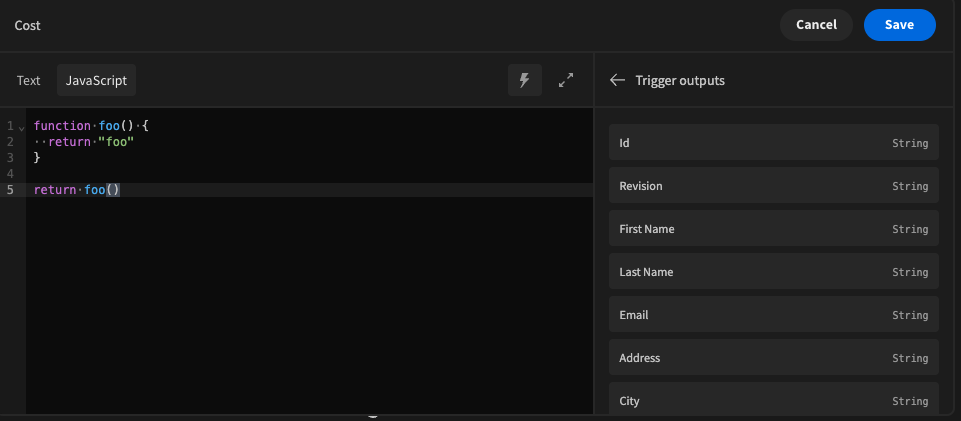 Due to a [vulnerability in vm2](https://github.com/advisories/GHSA-cchq-frgv-rjh5), any environment that executed the code server side (automations and column formulas) was susceptible to this vulnerability, allowing users to escape the sandbox provided by `vm2`, and to expose server side variables such as `process.env`. It's recommended by the authors of `vm2` themselves that you should move to another solution for remote JS execution due to this vulnerability. ### Patches We moved our entire JS sandbox infrastructure over to `isolated-vm`, a much more secure and recommended library for remote code execution in 2.20.0. This also comes with a performance benefit in the way we cache and execute your JS server side. The budibase cloud platform has been patched already and is not running `vm2`, but self host users will need to manage the updates by themselves. If you are a self hosted user, you can take the following steps to reproduce the exploit and to verify if your installation is currently affected. Create a new formula column on one of your tables in the data section with the following configuration. 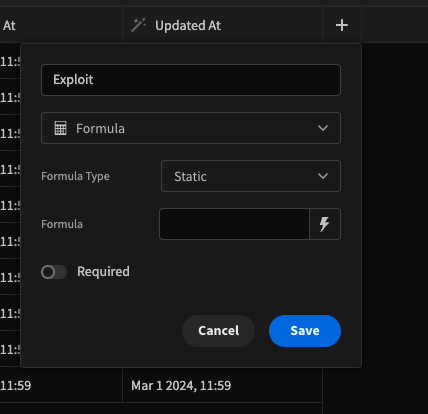 Add the following JS function to the formula and save. 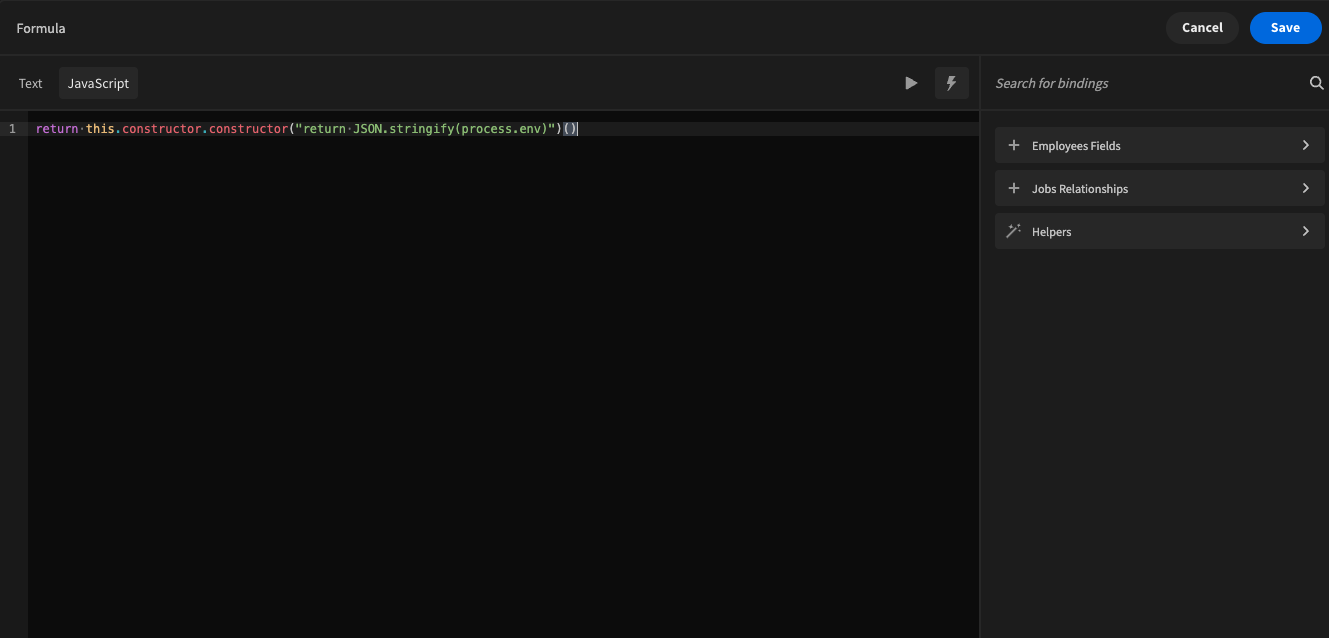 If your installation is vulnerable, when the formula evaluates you will be able to see the printed `process.env` in your new formula field. If not, your installation is not affected. ### Workarounds There is no workaround at this time for any budibase app that uses JS. You must fully migrate post version 2.20.0 to patch the vulnerability. ### References - https://github.com/advisories/GHSA-cchq-frgv-rjh5
- Published
- Mar 1, 2024
- Updated
- Aug 15, 2024
- EPSS
- —
- CWE
- CWE-94
Report tools
Action score
39
Low priority for now.
- CVSS
- 39 / 40 · 9.8 / 10
- CISA KEV
- 0 / 30 · Not listed
- EPSS
- 0 / 30 · —
Get told when this record changes
- Not in KEV: no record of exploitation in the wild
- No public exploit code on record
- A fix has been released
If any of these changes, we'll tell you in the daily email digest.
Is your version affected? Check itNoroxi analysis
What does it mean in your environment?
The assessment above is generated automatically from the record's data; it doesn't know your environment. Our team verifies on your systems whether this vulnerability is actually exploitable and which mitigation is enough.
We use this product, ask for helpAffected systems
Is your version affected?
Pick the product and type the version you run. It's compared with this record's version ranges in your browser; the version isn't sent anywhere.
| Vendor | Product | CPE |
|---|---|---|
| npm | @budibase/server | pkg:npm/%40budibase/server |
Package-level exposure
OSV and GitHub Advisory data: ecosystem, package and range. SBOM matching uses this table.
| Ecosystem | Package | Affected range | Fix |
|---|---|---|---|
| npm | @budibase/server | before 2.20.0 | 2.20.0 |
Remediation
Which version to upgrade to
Fix versions compiled from the vendor, package registries and Microsoft. Verify the vendor's note before upgrading.
| Product / package | Fixed version | Source |
|---|---|---|
| npm:@budibase/server | 2.20.0 | Package registry (OSV) |
Exploit status
No known public exploit
No public exploit has been observed yet. That doesn't mean you're safe, only that the bar is a little higher.
Research context
For pentesters and researchers: attack profile, score disagreement, timeline, patch commits, credits, variant and chain candidates, bug bounty scope. All derived from existing data; no exploit code.
Timeline
From publication to today: proof of concept, Metasploit module, CISA KEV and fix record. Dates are as reported by the sources.
No dated events beyond publication.
Patch and commit links
Commit, PR and diff links among the references. A starting point for patch-diffing and variant hunting; fixes, not exploits.
Not on record for this CVE: EPSS history · researcher credit · variant or chain candidate · public bounty program.
Technical details
Attack conditions
- Anyone who can reach it over the internet can trigger it.
- No account or password is required.
- No user action is required.
- No special conditions are required; it is repeatable.
If successful
- Confidentiality
- high · data can be read
- Integrity
- high · data or configuration can be modified
- Availability
- high · the service can be disrupted
- Attack vector
- Network
- Attack complexity
- Low
- Privileges required
- None
- User interaction
- None
- Scope
- Unchanged
- Confidentiality impact
- High
- Integrity impact
- High
- Availability impact
- High
Weakness class (CWE)
CWE-94 · Improper Control of Generation of Code ('Code Injection')CVSS vector
CVSS:3.1/AV:N/AC:L/PR:N/UI:N/S:U/C:H/I:H/A:H
osv
Attack context
MITRE CAPEC attack patterns and ATT&CK techniques for this weakness class (CWE). A starting point for detection rules and threat hunting.
Attack patterns (CAPEC)
Change log (1)
- Fix✗ → ✓
For records you follow, these changes also arrive as notifications. →
References
Show all references (3 more)Show less
Vendor advisories and official records. Exploit/PoC links are deliberately left out.